Friday, July 13, 2007

Model of a working limb


This is a project where we had to make a model of a working limb. It is going to show how muscle is attached to bone and how movement happens.


In this picture you can see the supplies I used. Mainly play dough, some paper and pipe cleaners.


This next picture is of the first bone in my model. It is the femur (the thigh bone) you can also see where the ball at the top of the bone would go into the hip joint.


This next picture is of the bone in your lower leg. They are the tibia and the smaller bone is the fibula.


This picture is showing a knee cap at the joint where the two bones meet. This bone is called the patella.
This image is of the whole leg bone.


Here is another showing where the foot would be.

The red play dough on top of the white bone is meant to represent muscle tissue. This muscle group is the quadriceps femoris. These are the muscles on the front side your thighs.


This picture has yellow playdough representing the tendons that attach muscle to bone. This allows the muscle to move the bone.


This picture is showing the movement at the joint. The leg is bent.


The blue play dough represents the neurons that carry a message to the muscle telling it to contract. This is also called an action potential or nerve implulse.

This is a picture of the schwann cells or myelin sheath that cover a neuron.


This is a model of Motor neuron notice the cell body with a nucleus. The long strand is the axon it has schwan cells in light blue covering it. At the end of the strands are axon terminals. Nerotransmitters are stored in the axon terminals. They help send messages from one neuron across to the next.


This is an image of how an action potential is carried out on a myelinated axon. The action potential or nerve impulse is kind of passed on from one section to the next. This happens very quickly.


This picture is of all the parts of a muscle cell working together to contract or relax. Muscles contract by impulses being sent to a T tubules calcium is released and the sarcomeres shorten. You can see in the model that this is a sliding filament process. "The actin filaments slide past the myosin filaments an approach one another." (Pg232 Mader)


Relaxed


Contracted


In conclusion you can see how all of these parts help us move. Fom our brain sending a nerve impulse down telling use to move our limb. To the tendons making it possible for the muscle to move the bone. The whole system works together to cause movement.
Work Cited:
Madder, Sylvia S. “Human Biology” 10th ed. New York: McGraw-Hill, 2007.

Sunday, July 8, 2007

UNIT III LAB 1 leaches


Unit 3 Lab 1


For this lab we had to do an online simulator of dissecting a leach and studying its neurons.
Here are the assignment questions.
1. What is the electrode measuring?
The electrode is measuring the activity of the neurons.
2. Why use leeches in neurophysiology experiments?
Because people don’t feel sorry for leaches like they would a mouse or any other kind of animal. They also have easily accessible neurons.
3. What is the difference between a sensory and a motor neuron?
A sensory neuron sends messages to the central nervous system. A motor neuron sends messages away from the nervous system to muscles etcetera telling them what to do. 4. Do you think a leech experiences pain? What is pain?I think that they do because they have nerves that can transmit pain to the brain. Pain is a feeling you perceive in your nerves but it is translated as ouch by your brain.
5. What were the two most interesting things about doing this lab?
It was fun to be able to just push a button and watch the leach be pined and cut open. It was also interesting how many neurons a tiny leach has.
6. Anything you found confusing or didn't like about the lab?
It’s hard to know if I got the right picture for the assignment sometimes I’m not sure of these online labs if I’ve done it right or not.
The pictures are from the website showing the procedure.


UNIT III muscle lab

Lab Paper unit 3 Muscles

For this lab project we were asked to experiment with our muscles. What happens when a muscle is relaxed and what about when it is flexed? What would happen after repeated use and what about after cold exposure? For these experiments we were asked to measure our bicep relaxed and then flexed. We were asked to repeatedly open and close our hand, making a fist. The final experiment was to hold your hand in ice water for a minute and then count how many times you could make a fist in 20 seconds. Then we had to take a look at the results and compare them with the before results.

For this experiment I was able to make a fist ten less times after my muscles were exposed to ice water. My hand ached because of the cold and when I pulled it out of the bowl my muscles were contracted or curled. They didn’t want to open up easily.

Figure 1: Effect of Temperature on Muscle Action

Temperature
Number of Fists
Normal 37
Ice Water 27
------------------------

For this experiment I had to hold a ball in the palm of my hand and make a fist as many times as I could in 20 seconds. The only problem is that you muscles get tired from repetitive use, so after a while you can do fewer and fewer fists.
Figure 2: Effect of Fatigue on muscle action

Trial
# of Squeezes in 20 seconds
9 More X's
1 37

----------------------------------------
2 35
----------------------------------------
----------------------------------------
3 33
----------------------------------------
----------------------------------------
4 31
----------------------------------------
----------------------------------------
5 31
----------------------------------------
----------------------------------------
6 31
----------------------------------------
----------------------------------------
7 28
----------------------------------------
----------------------------------------
8 30
----------------------------------------
----------------------------------------
9 30
----------------------------------------
----------------------------------------
10 28
----------------------------------------
----------------------------------------


Please excuse the spacing on this chart; I couldn’t get it to let me write in the further over boxes.


ANALYSIS OF DATA:

What are the three changes you observed in a muscle while it is working (contracted)?
The muscles became larger around but shorter in length. They are hard when contracted. After time muscles get tired and can’t perform as quickly as before.


What effect did the cold temperature have on the action of your hand muscles? Explain.

The cold made my fingers curl. It hurt after a while in the ice. My fingers didn’t want to open and close as quickly.


Question 4: What effect did fatigue have on the action of your hand muscles? Explain.

After a while of use it is harder and harder to keep up the same rate of speed as when you first started. The muscle gets tired of repetitive use.


For Conclusion I believe that during cold the muscles contract to help maintain body temperature. This is done by breaking down ATP which in turn releases heat. So after exposing my hand to freezing water the muscles were contracting to generate heat. Once I removed my hand my fingers were still contracted due to the cold. This made it harder to open and close them. Muscles fatigue because the have depleted their energy reserves. A muscle contracts when calcium leaves the sarcoplasmic reticulum and it relaxes when calcium returns. So if you rapidly make a fist over and over the muscle doesn’t have a chance to relax. This causes it to get fatigued and not work as well. So these experiments were good examples of muscle fatigue and temperature retraction.

Friday, July 6, 2007

Ethical Issue Essay


What can we do as a country to prevent the obesity crisis?

The problem is that adults and children in our country are getting increasingly over weight. What can we do to help prevent this problem and how do we get people to exercise? I think exercise is something that needs to be taught to you as a child. We need to start making it a daily part of a child’s life. It seems crazy to me that our kids only have PE once a week at school. We as a country need to work hard to get the funding schools need to improve physical activity at school. It shouldn’t cost children money to join in after school sports. Some families just can’t afford to pay for their children to join in sports. So these children don’t get all the opportunities that other children have. Instead they probably end up watch TV and sitting on the couch. When they could have been out have fun and getting exercise. We need to put an emphasis on exercise in all of our schools in this country. In this way the adults of the future will be healthier.
We also need to make it safer to exercise by putting in sidewalks with any new construction. Let’s face it cycling to work for an adult is just not safe. There are always bicyclists getting hit by cars that didn’t see them. It would be nice if it were practical to ride your bike to work but most of us commute a ways to work/school. If towns made the roads more bicycle friendly maybe more people would get out and ride. They could also figure out some kind of tax break for people who don’t drive very often.
The media does seem to have a huge part in our country’s obesity. The commercials tell us to eat their fattening food. We also exercise less because we as a country watch a lot of TV. We go to the movies instead of hiking. We read all the gossip magazines instead of doing more positive things with our bodies. But at the same time you can’t blame the media for everything. We each have our own brains and can make decisions for ourselves. Maybe our country could work on making it a little easier for everyone by funding more parks and sidewalks. If each community just dedicated more effort to making exercise important it would make a big difference.

Work cited: Bike picture: http://www.nhtsa.dot.gov/people/injury/pedbimot/bike/KidsandBikeSafetyWeb/index.htm
Kid’s sports: http://www.lynchburgymca.org/pages/kids-sports.htm

UNIT III Compendium review 1


Unit III Compendium Review 1
• What does the nervous system do?

• Diffusion and Action Potentials in Neurons--
rapid transmission of messages

• Reflex arc (simple somatic function)
and autonomic function

• What can we sense?


(Picture of the nerves in a humane body.)


What does the nervous system do:
There are two parts to the nervous system; the central nervous system (CNS) and the peripheral nervous system (PNS). The central nervous system is the made up of the brain and the spinal cord. The peripheral nervous system is the nerves that run threw out the human body. The CNS receives input or signals and sends messages to the nerves in the PNS to function or react. So if you stub your toe the nerves in your toe send a ouch message up your spinal chord to your brain. The nervous system doesn’t only send pain messages. It can send any kind of massage hot, cold, soft or hard. Or nerves system lets our brain know what is going on.
(This is a picture of of a myelin sheath on an axon.)


Diffusion and action potentials in neurons, rapid transmission of messages:
Neurons are transmitter cells that send signals threw out the nervous system. Neurons are the main cells in our brains; they don’t divide like other cells. Action potential is the processes of sending a message down a nerve. An action potential is the same thing as a nerve impulse. Nerve impulses travel 1.0 m/second – 100m/second. This speed in sending an impulse is so fast that it’s amazing. These impulses are sent down a nerve fiber or axon. Axons conduct nerve impulses. Long axons usually have a protective covering called Schwann cells. It is a myelin liquid substance. It does not cover the whole axon; it covers with gaps in between each one. The gapes are called nodes of Ravier. Myelin sheaths have several purposes, they insulate and they help regenerate new fiber growth if there is damage to the axon. When an axon has a myelin sheath the action potential is sent from Ranvier node to Ranvier node. Axons have many branches at the end of the branches are axon terminals. These are right next to other neurons. The space between them is called the synaptic cleft. This gap separates sending and receiving neurons. Instead there are molecules called neurotransmitters that carry messages a crossed. These neurotransmitters are kept inside the axon terminal.


(Here is a picture of an axon. Notice the enlarged picture in the corner, this is a axon terminal.)


Reflex arc (simple somatic function) and autonomic function:
The nerves in the somatic system serve the skin, skeletal muscles and tendons. (Mader 263) The reflex arc is a response to a stimulus. This could be responding to pain or to the pleasant smell of a flower. If its pain your nerves send a message to your spinal chord and up to your brain to move or jump back and react. For example if you burn yourself you automatically jump back o pull your arm away from the stove. The autonomic function is automatic operation of your organs. You don’t have to tell your heart to pump or your stomach to digest food. The autonomic system regulates them to keep them going as there suppose to.
(This is a picture of skin, notice the nerves in the skin.)
What can we sense:
Our bodies have sensory receptors that detect stimuli, things like smells tastes and sounds. Exteroceptors detect things that happen to the outside of our bodies. Interceptors detect things going on inside our bodies like blood pressure. There are four kinds of sensory receptors chemoreceptors, pain receptors, photoreceptors and mechanoreceptors. Chemoreceptors detect taste and smell they also monitor blood ph inside the carotid arteries and the aorta. Pain receptors alert use to danger. They let us know when we are pushing or bodies to hard or when we are touching something sharp or hot. Photoreceptors provide us with our vision they sense light and colors. Mechanoreceptors detect gravity, motion and help us maintain our balance. Sensory receptors send messages to our brain that lets us know what we are experiencing. Our senses control all kinds of things. They let us know where are limbs are meaning we can close our eyes and still know what we are doing with our limbs. Our skin can sense touch good or bad. We taste things because we have thousands of little tiny taste buds that sense the different flavors. We also smell things while we taste them, so we can associate a good smell with something that also tastes good. We can also detect bad smells like when food is rotten. Our vision might be one of our most important senses. We can see things coming and respond by getting out of the way of danger. Our hearing helps us communicate and also lets us hear things coming like if we are crossing the street and hear a truck coming. All of these senses send nerve impulses to our spinal cord and up into our brain so that we can respond.
(This is an ear, part of our senses.)
(This is a picture of the human eye, another one of or senses.)

UNIT III Compendium review 2

Unit III Compendium review 2

• Muscle Cells, Contraction and Calcium
• Movement Across Joints
• Bones, Bone Tissue and Calcium


Muscle cells, contraction and calcium:
We have three kinds of muscles skeletal, smooth and cardiac. Muscle cells are like bands; so for this reason they are called muscle fibers. Smooth muscle cells are involuntary meaning they contract and perform their task without us telling them to. Examples would be the walls of internal organs. Cardiac muscle is the muscle that makes up the walls of the heart, it is also involuntary. Skeletal muscle is usually attached to the skeleton; we control its movement. Unlike the other two kinds of muscle fibers, skeletal muscles are multinucleated; meaning they have multiple nucleuses. Skeletal muscles help keep our body temperature regulated. They keep us warm in the winter. Muscles along with bones help us to stay up right. The fibers in our muscles are surrounded by connective tissue that holds them all together. Muscles are attached to bones by tendons. When we move our muscle it in turn pulls the tendon causing our bone to move as well. When we bend our arms the muscles contract and shorten. Our nerves send a message to an axon to contract. The axon can tell several muscle fibers to contract. For a muscle to move all of the muscle fibers that make up that particular muscle must contract. Muscle fibers shorten by actin filaments sliding past myosin filaments. Calcium ions are released when this happens. Muscles require ATP for contraction. ATP is broken down to ADP for an energy source. Muscle cells also use plasma fatty acids and blood glucose as energy sources.


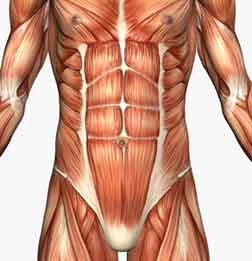
This is a picture of muscles in the human body.


Movement across joints:
There are three kinds of joints, fibrous joints, cartilaginous joints and synovial joints. Fibrous joints are not mobile; an example is the bones of the skull are attached by sutures of the cranium that do not move. Cartilaginous joints like in our ribs and sternum move slightly. Synovial joints are filled with synovial fluid as a lubricant. This helps bones move against each other with out pain. Joints can be like the elbow hinge joints that move mainly in one direction and back. They can be like our hip; ball and socket joints that allow movement in almost all direction.
This is a knee joint. Notice the cartlige pading the two bones.
Bones, bone tissue and calcium:
Our bodies have over 200 bones in them. They are there for many different reasons. They support our body so that we can stand up right. Our spine is made up of bones that protect our spinal chord and help us stand up. Bones help protect our vital organs. For example our heart is hidden behind our rib cage. So if you were hit in the chest your ribs would protect your heart from damage. Bones can repair themselves when broken or fractured. Bones have many functions. They produce blood cells. They also store minerals, fat and most importantly calcium. Perhaps one of the most noticeable things that bones do is movement. We have joints in our bodies so that we can function and move. Another important part of movement is cartilage. The ends of our bones are padded with cartilage so that the joints aren’t rubbing bone to bone. Other parts of our body contain cartilage too. Our ears are made of cartilage and so is part of our nose. Cartilage is more flexible than bone. Unlike bone cartilage does not contain blood vessels; this causes it to be slow to heal. Ligaments and tendons are fibrous connective tissues. They help connect bone to bone and muscle to bone at the joints. Bones are constantly being broken down and regenerated on the inside. They are broken down by osteoclasts. Osteoclasts help put calcium and phosphate into our blood stream. Osteoblasts are the cells that form new bone. “As much as 18% of bone is recycled each year.” (Mader 212) This is done by the constant processes of cells breaking down bone and other cells regenerating. This process also allows the body to maintain calcium levels in the blood. Our bodies need calcium for many reasons besides our bones needing them; we also need it for our blood to clot. Calcium has to be kept at a curtain level if it is too high or too low problems occur.
Osteoporosis is a condition where bones are weak and brittle because of decreased bone mass. After ages 40-50 years old bones begin to break down more than they rebuild. This leads to weaker bones and easily broken bones. This is a big problem in older women. Men’s bones are denser than women to begin with and they don’t break done as much as women’s do. Older women especially seniors often suffer from hip fractions from the smallest fall. Doctors recommend eating a diet high in calcium your entire life to help prevent this. Calcium helps keep your bones denser, exercise also helps with this.
Work Cited:
Madder, Sylvia S. “Human Biology” 10th ed. New York: McGraw-Hill, 2007.
Knee jointhttp://www.bio.psu.edu/people/faculty/strauss/anatomy/skel/knee.htm

Saturday, June 30, 2007

Self Evaluation

REGARDING YOUR OWN PERFORMANCE1. What were the three aspects of the assignments I've submitted that I am most proud of?
I think I did a good job of using pictures for each assignment.

2. What two aspects of my submitted assignments do I believe could have used some improvement?
I’m not sure if I made all of the essays long enough. I could have picked more physically challenging activities for my lab project.

3. What do I believe my overall grade should be for this unit?
I hate this question because it’s kind of like a trick question. Of course everyone wants to say A but they don’t want to be conceded. I’m not sure I feel like I didn’t work as hard on this one as I did the last one, but this one was a lot less chapters than the last one. It was also I think easier material to cover. I would like to say low A or a B.

4. How could I perform better in the next unit?
By trying to include references other than the text book.
At what moment during this unit did you feel most engaged with the course?
I liked the first online blood pressure lab.
At what moment unit did you feel most distanced from the course?
Trying to get to the store over and over to use their machine.

What action that anyone (teacher or student) took during this unit that find most affirming and helpful?
I’m not sure this applies because we don’t really work with the other students.
What action that anyone (teacher or student) took during this unit did you find most puzzling or confusing? Same as above.

What about this unit surprised you the most? (This could be something about your own reactions to the course, something that someone did, or anything else that occurs to you.) I think I was most surprised at how much your blood pressure varies.